
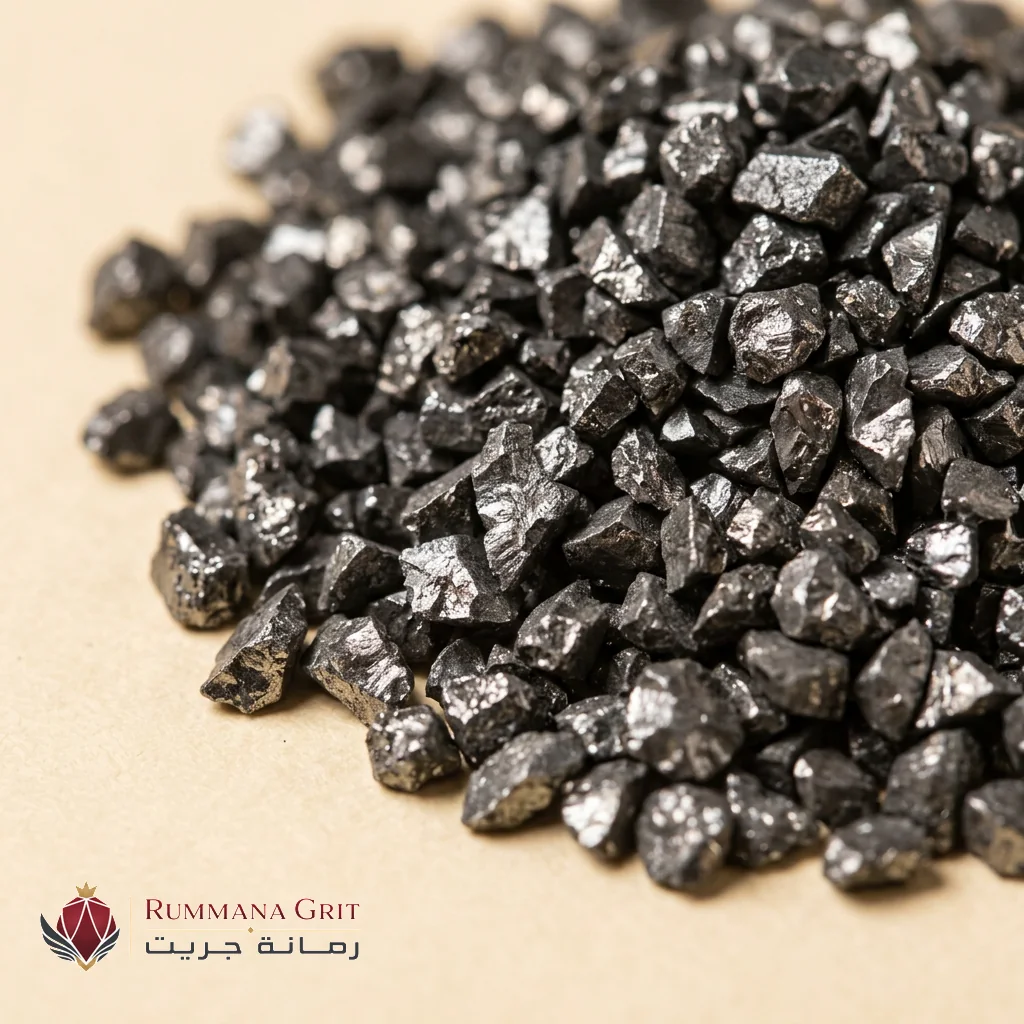
Steel Shot & Steel Grit
Compare six Rummana Grit steel-media families: high-carbon shot, low-carbon shot, angular grit, carbon cut wire, stainless shot and chromium-bearing alloy grit. Start with shape and process, then qualify size, hardness, machine compatibility and lot evidence.
Family ranges and hardness figures are source-catalogue references, not stock or certified batch properties. S330 hardness and chemistry remain unverified; G25 GP detailed targets remain proposed purchase-review criteria. No batch-confirmed results have been provided.
How to read the technical information
Source-supported family information and recorded designations: public product-family descriptions and the named selections establish context, not confirmed inventory or batch conformity.
Typical qualitative behavior: application guidance describes how a material family may behave; qualify the actual grade and operating conditions.
Preliminary or proposed targets: explicitly marked figures are for purchase review, not supplier guarantees or certified results.
Batch-confirmed evidence: none provided. Sample observations, where stated, are not delivery acceptance evidence.
Six steel-media families compared
Rummana's steel-family catalogue provides the following selection vocabulary. All ranges and typical hardness figures require grade- and lot-specific confirmation; the table is not a stock list, certification or promise of machine compatibility. A catalogue family hardness band does not establish the properties of the S330 lot under review.
| Family | Shape and size basis | Hardness / structure | Process selection |
|---|---|---|---|
| High-carbon steel shot | Round; S70–S780 catalogue scope. State catalogue sizing or SAE J444 sieve limits. | Typical catalogue 40–50 HRC; tempered martensite. Confirm lot; S330 remains unverified. | Wheel/air cleaning and descaling; peening requires separately qualified media, intensity and coverage. |
| Low-carbon steel shot | Round; size by qualification, not an assumed S-range. | Bainitic structure described by source; confirm hardness and lot microstructure. | Evaluate cleaning/descaling in compatible wheel/air systems. Do not infer peening approval from shape or structure. |
| Angular steel grit | Catalogue sizes 12–80; GP/GL/GH hardness classes, including G25. Catalogue labels are not SAE conversions. | Class and lot hardness require confirmation. G25 GP 40–51 HRC is a proposed target only. | Rust/mill-scale removal and profile generation. Match class to wheel/air equipment limits and recovery. |
| Carbon steel cut wire | CW0.4–CW2.0 nominal wire-diameter catalogue range; cylindrical as-cut or rounded conditioned. | Hardness, chemistry and condition by batch qualification. | As-cut grain and conditioned grain give different impact/finish behavior. Specify conditioning and shape limits for peening; confirm wheel/air suitability. |
| Stainless steel shot | Round; 304/410 grades with grade-dependent sizes. | Hardness and material grade must be confirmed; do not infer them from stainless designation alone. | Evaluate for stainless/non-ferrous parts where ferrous contamination matters; verify media purity and surface results, not a contamination-free guarantee. |
| Chromium-bearing alloy grit | Angular; GH12–GH80 source catalogue labels. | Chromium-bearing alloy/bearing steel; hardness requires confirmation. GH label is not a certified hardness result. | Evaluate cutting/profile duty in compatible equipment; qualify chemistry, hardness, wear and recovery before wheel/air use. |
S330 round shot and G25 GP angular grit
Round shot generally produces an impact-led cleaning action, while angular grit generally cuts and develops a surface profile. Actual results depend on the substrate, abrasive condition, working mix and machine settings; no cleaning rate, profile, consumption or service-life guarantee is made.
S330 is the round-shot designation under review. Its hardness, chemistry and batch properties are unverified. Do not inherit the G25 GP targets or proposed material description for S330. Generic numerical catalogue data on the public shot page is not reproduced as an S330 specification.
For G25 GP, high-carbon cast steel with a tempered-martensite microstructure is a proposed material description, not a batch-verified finding. Require the supplier's confirmed grade definition, heat-treatment description and microstructural examination where specified.
G25 GP proposed purchase-review targets
The following figures are proposed G25 GP purchase-review targets, not certified results or established delivery limits. Obtain explicit supplier agreement and lot-linked test evidence before acceptance. They do not apply automatically to S330 or any other grade.
| Parameter | Proposed target or reference | Interpretation and evidence required |
|---|---|---|
| G25 sizing | Nominal sieve reference 0.71 mm | A sieve reference, not a uniform particle diameter. Obtain the complete agreed sieve distribution and test report. |
| GP hardness | 40–51 HRC | Purchase-review target only; confirm method, sampling and lot results. GP is a hardness designation, not a size conversion. |
| Material density | ≥7.0 g/cm³ | Proposed material-density target, not bulk density. Confirm the test method and actual result. |
| Carbon (C) | 0.70–1.20% by mass | Proposed chemistry; no certified result provided. |
| Silicon (Si) | ≥0.40% by mass | Proposed chemistry; no certified result provided. |
| Manganese (Mn) | 0.40–1.20% by mass | Proposed chemistry; no certified result provided. |
| Sulfur (S) | ≤0.05% by mass | Proposed chemistry; no certified result provided. |
| Phosphorus (P) | ≤0.05% by mass | Proposed chemistry; no certified result provided. |
GP catalogue grade labels: approximate diameters
Rummana's catalogue chart uses the GP labels below. These approximate diameters are not SAE J444 sieve limits or equivalent G designations, and are not proof of stock or batch sizing. GL/GH size availability must be confirmed separately, not inferred from this GP chart.
Keep the G25 proposed purchase targets above as a separate specification basis: catalogue GP25 at approximately 1.0 mm does not establish SAE J444 G25 conformity or replace its nominal 0.71 mm sieve reference. Obtain the agreed complete sieve distribution and lot report.
| Catalogue label | Approximate diameter | Qualification |
|---|---|---|
| GP12 | 2.0 mm | Confirm distribution and sizing basis. |
| GP14 | 1.7 mm | Confirm distribution and sizing basis. |
| GP16 | 1.4 mm | Confirm distribution and sizing basis. |
| GP18 | 1.2 mm | Confirm distribution and sizing basis. |
| GP25 | 1.0 mm | Not proof of SAE J444 G25 conformity; keep proposed G25 targets separate. |
| GP40 | 0.8 mm | Confirm distribution and sizing basis. |
| GP50 | 0.6 mm | Confirm distribution and sizing basis. |
| GP80 | 0.5 mm | Confirm distribution and sizing basis. |
GP / GL / GH: independent industry hardness references
These bands are independent industry references reported by the source, not Rummana supplier specifications or lot results. Size and hardness are separate selections. Confirm hardness method, sampling and lot results before purchase; overlapping bands do not make classes interchangeable.
| Class | Industry reference | Selection context |
|---|---|---|
| GP | 40–51 HRC | Relatively softer; may round in service as the working mix evolves. Confirm actual lot behavior. |
| GL | 54–61 HRC | Intermediate; may retain angular edges longer than GP. Qualify profile and machine compatibility. |
| GH | ≥60 HRC | Harder; mainly considered for air blast. Wheel-blast use requires equipment-maker approval and process qualification. |
Size designations, sieve reports and applicable references
SAE J444 S/G labels are defined by sieve limits, not automatic conversions of catalogue approximate particle-diameter numbers. An S designation sold on a catalogue-diameter basis does not demonstrate SAE J444 conformity. State the sizing system explicitly and request the lot sieve report. CW labels refer to nominal wire diameter, not SAE S/G classes; GH12–GH80 alloy-grit labels also need their own confirmed sizing basis.
Other S/G sizes, such as S230, S390, G40 and G50, are selection examples only, not confirmed stock. A supplier label such as GP25 must not be treated as a generic equivalent of SAE G25. Size designation and GP/GL/GH hardness class are separate choices.
The source retention basis is ambiguous, so no definitive retained or passing percentages are reproduced. Agree the standard edition, sieve stack, apertures, cumulative or individual retention basis, sampling method and acceptance limits in writing, then obtain the lot's sieve report.
SAE J444 addresses cast-shot and grit sizing; SAE J1993 addresses high-carbon cast-steel grit; ISO 11124-3 addresses high-carbon cast-steel shot and grit for blast-cleaning. ISO 11124-4 and ISO 11124-5 are references for low-carbon cast-steel shot and cut steel wire respectively. Apply only the relevant scope and agreed edition; mention of a standard is not a certificate or a claim that any selection complies.
Cleaning, profile and qualified peening
Shape comes first: round shot and conditioned cut wire favor impact-led cleaning or qualified peening; angular grit and as-cut wire produce different cutting and profile effects. Larger grains generally deliver more energy per impact but fewer impacts for a given mass. Size, velocity and coverage must be balanced on the actual workpiece.
Hardness and friability affect profile, breakdown and equipment wear. Harder media may retain or develop a more aggressive cutting action, but do not assume faster cleaning, longer life or lower consumption. GP/GL/GH selection requires machine-maker compatibility review, particularly for harder media in wheel-blast systems, and a representative process trial.
Shot may be considered for cleaning castings, forgings or other suitable metal surfaces. Shot peening is a separately qualified process: establish media condition, qualified intensity and coverage, equipment control, inspection and the component-specific procedure. A round shape or S330 label does not qualify a peening process.
Angular grit may be considered for rust and mill-scale removal and development of an anchor profile. Qualify the selected hardness, size distribution and operating settings against the substrate and coating specification. Neither G25 nor GP alone guarantees a required cleanliness or profile.
Review compatibility with the actual wheel-blast or air-blast equipment, including permitted media, wear parts, metering and operating settings. Metallic media is not automatically suitable for every substrate; assess ferrous contamination and embedment, particularly on contamination-sensitive materials.
For recirculating systems, check recovery, separation, dust extraction and the evolving working mix, not just fresh abrasive size. Broken grains, fines, contaminants and replenishment change the process. Validate the operating mix and monitor results without assuming a guaranteed reuse count or performance.
Inspection gaps to close before purchase
Request a lot-linked sieve analysis, hardness report, chemical analysis and confirmation of particle shape. Where required, specify microstructure, cracks, voids, foreign matter and other defect checks with agreed test methods and acceptance limits. The proposed G25 tempered-martensite description still needs evidence.
Distinguish material density from loose or tapped bulk density when specifying tests, packaging or machine charge. The proposed G25 material-density target is not a measured bulk-density value. No density, hardness or chemistry target from G25 is assigned to S330.
Confirm the substrate condition and contaminants, coating removal requirements, cleanliness and profile inspection, and peening intensity/coverage where relevant. Qualify representative media in the intended equipment before order and retain agreed reference samples and acceptance records.
Documentation, lot traceability and acceptance
A technical data sheet (TDS) supports material selection; it is not proof that an individual delivery meets purchase requirements. Agree the grade, test methods, sampling plan, tolerances and acceptance limits before order. A certificate of analysis (COA) must identify the supplied lot, actual test results and methods, with traceability through bag markings, packing records and delivery documents.
Obtain the current safety data sheet (SDS) for handling, storage, personal protection and dust controls. Assess dust from the abrasive and from the substrate or removed coating, including any hazardous contaminants. Product chemistry alone does not establish the exposure risk of blasting waste. Specify ventilation, dust collection, housekeeping and waste disposal for the actual process.
No batch-confirmed results, lot-linked COA, verified sieve report or complete physical test evidence have been provided for these selections. Public catalogue descriptions, sample analyses and proposed purchase targets are different evidence classes; none establishes certification, availability or a supplier performance guarantee. Resolve missing evidence and qualify a representative sample in the intended process before order.
Public product references and evidence limits
Six-family catalogue comparison, including S70–S780, typical high-carbon shot 40–50 HRC, cut wire CW0.4–CW2.0, stainless grades and GH12–GH80 alloy grit; not lot-certified properties or stock.
Public grit-family context; proposed G25 GP targets require separate confirmation and lot evidence.
Public shot-family context only; generic catalogue numerical data is not a verified S330 specification.
These product pages provide source context, not independent verification of a supplied lot. The preliminary or proposed targets and any sample observations on this page must not be represented as public-source guarantees, certification or confirmed availability.
Establish the specification with Meritus
Send Meritus the shot or grit designation, process and equipment, substrate, required cleanliness/profile or qualified peening requirements, sieve and hardness acceptance criteria, quantity and destination. Keep proposed G25 targets separate from the unverified S330 specification and resolve the retention basis before order.
Contact Meritus about procurement requirements