
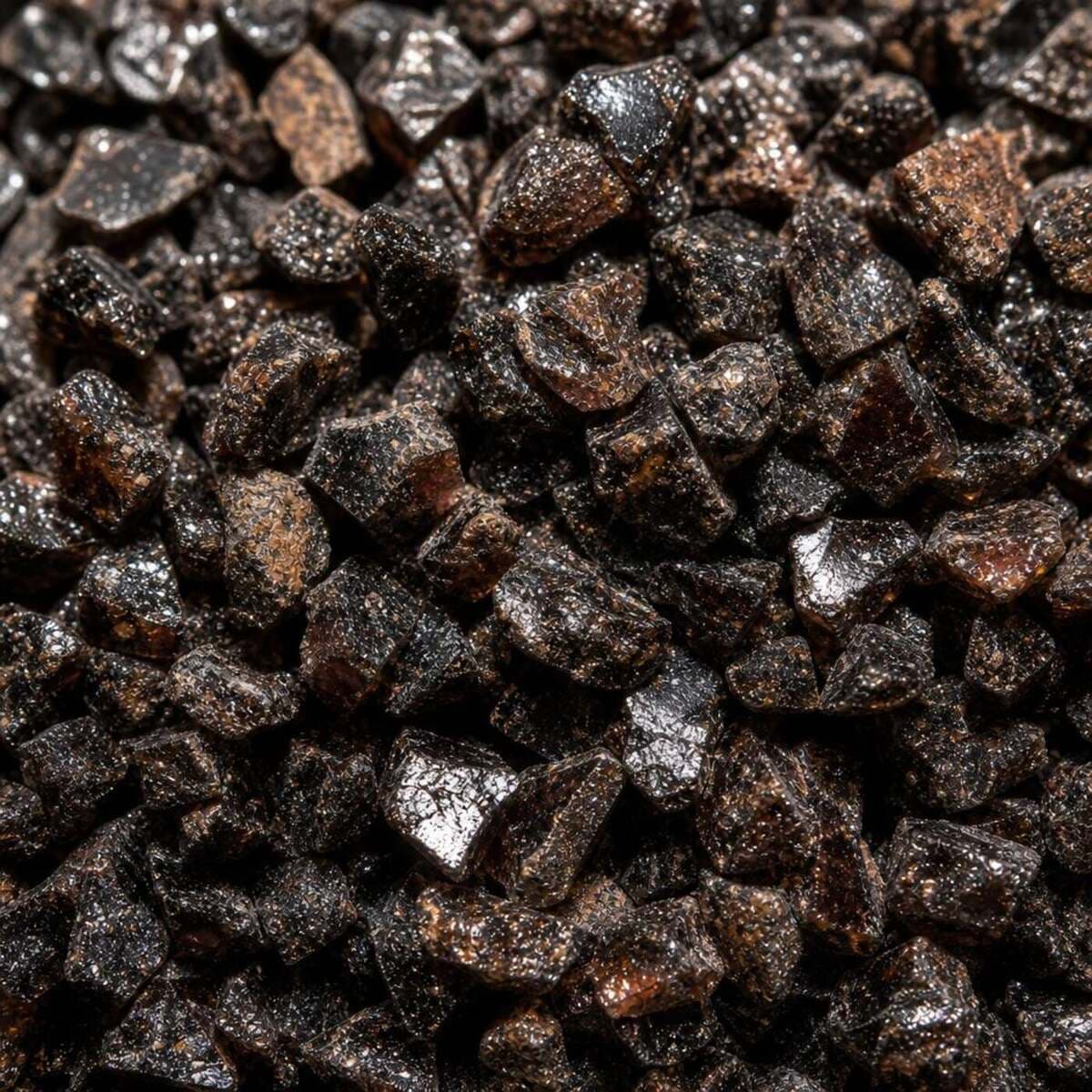
Copper Slag Abrasive
Copper slag is a smelting-derived iron-silicate abrasive with angular dark brown to black grains. Select Rummana Grit reference grades against the substrate, coating system, required cleanliness and surface profile, then confirm the delivered material with lot-specific tests.
Reference grades: 5/20, 20/40, 40/80 and 80/120 mesh. The numerical values below are typical and batch-dependent, not certified batch results, guaranteed performance or confirmed stock. Meritus is the procurement contact for specification review and evidence requests.
How to read the technical information
Source-supported family information and recorded designations: public product-family descriptions and the named selections establish context, not confirmed inventory or batch conformity.
Typical qualitative behavior: application guidance describes how a material family may behave; qualify the actual grade and operating conditions.
Typical numerical values: catalogue reference figures vary by grade and batch. They are not certified results or guaranteed delivery limits.
Preliminary or proposed targets: explicitly marked figures are for purchase review, not supplier guarantees or certified results.
Batch-confirmed evidence: none provided. Sample observations, where stated, are not delivery acceptance evidence.
Reference grades and sieve-based selection
Mesh ranges are reference designations, not verified size distributions or exact particle diameters. Agree the sieve standard, apertures, sampling procedure, oversize/undersize limits and whether retained results are individual or cumulative. Obtain a lot-specific sieve report before accepting a grade.
Coarser grains may be evaluated for heavier removal or a more pronounced profile, and finer grains for lighter preparation or more controlled finishing. Do not assign a guaranteed profile to a mesh label: abrasive shape, pressure, nozzle, stand-off, angle, substrate and operator conditions all matter.
| Reference grade | Trial selection context | Confirm before purchase |
|---|---|---|
| 5/20 mesh | Coarse selection to evaluate for heavy rust, mill scale or coating removal on suitable robust steel. | Sieve distribution, nozzle compatibility and risk of excessive profile. |
| 20/40 mesh | Selection to evaluate for general hull, tank, bridge and structural-steel blasting. | Cleanliness and profile against the coating specification. |
| 40/80 mesh | Finer selection to evaluate where a more controlled finish is required. | Removal effectiveness, fines content and achieved surface profile. |
| 80/120 mesh | Fine selection for application-specific preparation trials. | Flow, dust, substrate suitability and the specified finish; no universal suitability assumed. |
Typical physical properties — batch-dependent
These reference figures support initial selection only. Agree purchase acceptance limits and methods separately; a listed typical maximum is not a measured result or a guarantee for every batch.
Bulk density includes the voids between grains and depends on grading and the loose or tapped test method. True density describes the grain material. Do not use true density as the bulk loading or bag-volume value.
| Property | Typical reference value | Evidence required |
|---|---|---|
| Material and appearance | Smelting-derived iron silicate; angular, dark brown/black | Source identification, visual/shape assessment and relevant material analysis. |
| Hardness | Mohs ≥7 | Agreed hardness method and representative results; not a guaranteed cleaning rate. |
| Bulk density | ~1.9 g/cm³ | Measured result with loose/tapped method and grade stated. |
| True density | ~3.9 g/cm³ | Material-density method and lot result, distinct from bulk density. |
| Water content | Maximum 0.2% | Typical reference limit; agree moisture test and confirm actual lot value. |
| Free silica | <1% | Batch-specific free crystalline silica assessment with method and detection/reporting basis. |
XRF chemistry and the silica distinction
The following XRF oxide ranges are typical, batch-dependent composition references, not a supplied batch certificate. XRF reports elemental composition expressed as oxide equivalents; it does not by itself identify how much silica is present as a free crystalline phase.
Total SiO2 in iron-silicate slag is not the same measurement as free crystalline silica. A total SiO2 value of 25–35% does not mean 25–35% free crystalline silica. Conversely, the typical free-silica figure below 1% must not be inferred from XRF alone: obtain an appropriate phase-specific test, such as a suitable X-ray diffraction method, with detection limits and reporting basis.
Neither a low free-silica result nor total oxide chemistry makes blasting dust harmless. Assess respirable dust, the abrasive and contaminants released from the substrate or old coating, and follow the current SDS and site exposure controls.
| Oxide | Typical mass fraction | Qualification |
|---|---|---|
| Fe2O3 | 30–45% | Iron reported on an oxide-equivalent basis; confirm the batch XRF report. |
| SiO2 | 25–35% | Total silica on an oxide-equivalent basis, not a free crystalline silica measurement. |
| Al2O3 | ≤3% | Typical reference limit; confirm the batch analysis and agreed acceptance criteria. |
Hull, tank, bridge and structural-steel blasting
Evaluate copper slag for removal of rust, mill scale and existing coatings on ship hulls, tank surfaces, bridges and structural steel. Select the grade and operating conditions for the steel condition, coating thickness, access and the new coating system rather than assuming one grade suits every job.
For tanks and enclosed spaces, establish ventilation, containment, access and exposure controls appropriate to the work. On bridges and shipyard work, contain debris and prevent uncontrolled release to surrounding land or water. Removed coatings may introduce hazardous constituents into spent abrasive; assess waste and dispose of it under applicable local requirements.
Validate cleaning effectiveness and surface profile on representative steel before production blasting. Do not claim a fixed profile, cleaning speed, low-dust outcome, reuse count or consumption rate without process-specific evidence.
Specify, test and verify the blasting result
Document the coating system's acceptance criteria and the chosen test methods before purchase and trial. Record the grade, lot, equipment settings, substrate condition and inspection results so comparisons are meaningful.
| Criterion | What to specify and verify |
|---|---|
| Size and sieve | Agreed distribution, sieve stack, oversize/undersize and fines; lot-specific retained/passing results with a clear basis. |
| Surface profile | Required profile range and measurement method; verify after a representative blast trial at recorded operating settings. |
| Cleanliness | Required rust, mill-scale and coating removal standard; inspect the prepared steel and check residual dust before coating. |
| Soluble salts, chlorides and conductivity | Test abrasive extract using agreed methods and units. Conductivity screens soluble contamination but is not a chloride-specific result. Check the prepared substrate separately against the coating system limits. |
| Moisture | Confirm the lot water content, sampling and storage condition; evaluate flow and clumping rather than relying on the typical maximum. |
| Dust | Measure fines or dust generation under an agreed test or trial; assess worker exposure and dust remaining on the surface. No low-dust performance is guaranteed. |
| Consumption | Record abrasive mass per cleaned area to the agreed cleanliness and profile, along with pressure, nozzle, substrate and recovery conditions. Compare like-for-like; no fixed consumption or reuse count is claimed. |
Reference specifications and tests, not certifications
ISO 11126-3 is a reference specification for copper refinery slag used as a non-metallic blast-cleaning abrasive. The ISO 11127 series provides relevant sampling and test methods for non-metallic blast-cleaning abrasives. Select the applicable parts and agreed editions for grading, density, hardness, moisture, soluble contaminants and water-soluble chlorides as appropriate.
These references are not held certifications and do not establish conformity of any Rummana Grit batch. No ISO 9001 certification or blanket SSPC-AB conformity is claimed for this product. Where a project invokes an SSPC/AMPP requirement, specify the exact document, scope and acceptance evidence rather than relying on a general badge.
Documentation, lot traceability and acceptance
A technical data sheet (TDS) supports material selection; it is not proof that an individual delivery meets purchase requirements. Agree the grade, test methods, sampling plan, tolerances and acceptance limits before order. A certificate of analysis (COA) must identify the supplied lot, actual test results and methods, with traceability through bag markings, packing records and delivery documents.
Obtain the current safety data sheet (SDS) for handling, storage, personal protection and dust controls. Assess dust from the abrasive and from the substrate or removed coating, including any hazardous contaminants. Product chemistry alone does not establish the exposure risk of blasting waste. Specify ventilation, dust collection, housekeeping and waste disposal for the actual process.
No batch-confirmed results, lot-linked COA, verified sieve report or complete physical test evidence have been provided for these selections. Public catalogue descriptions, sample analyses and proposed purchase targets are different evidence classes; none establishes certification, availability or a supplier performance guarantee. Resolve missing evidence and qualify a representative sample in the intended process before order.
Public product references and evidence limits
Reference mesh grades, material image and typical physical/XRF values. Catalogue performance statements are not adopted as batch or process guarantees.
These product pages provide source context, not independent verification of a supplied lot. The preliminary or proposed targets and any sample observations on this page must not be represented as public-source guarantees, certification or confirmed availability.
Establish the specification with Meritus
Send Meritus the selected reference mesh grade, substrate and coating requirements, required cleanliness and profile, salt/chloride limits, intended equipment, trial and acceptance tests, quantity and destination. Request the current TDS/SDS and a lot-linked COA with sieve, chemistry and physical test evidence before accepting a delivery.
Contact Meritus about procurement requirements