
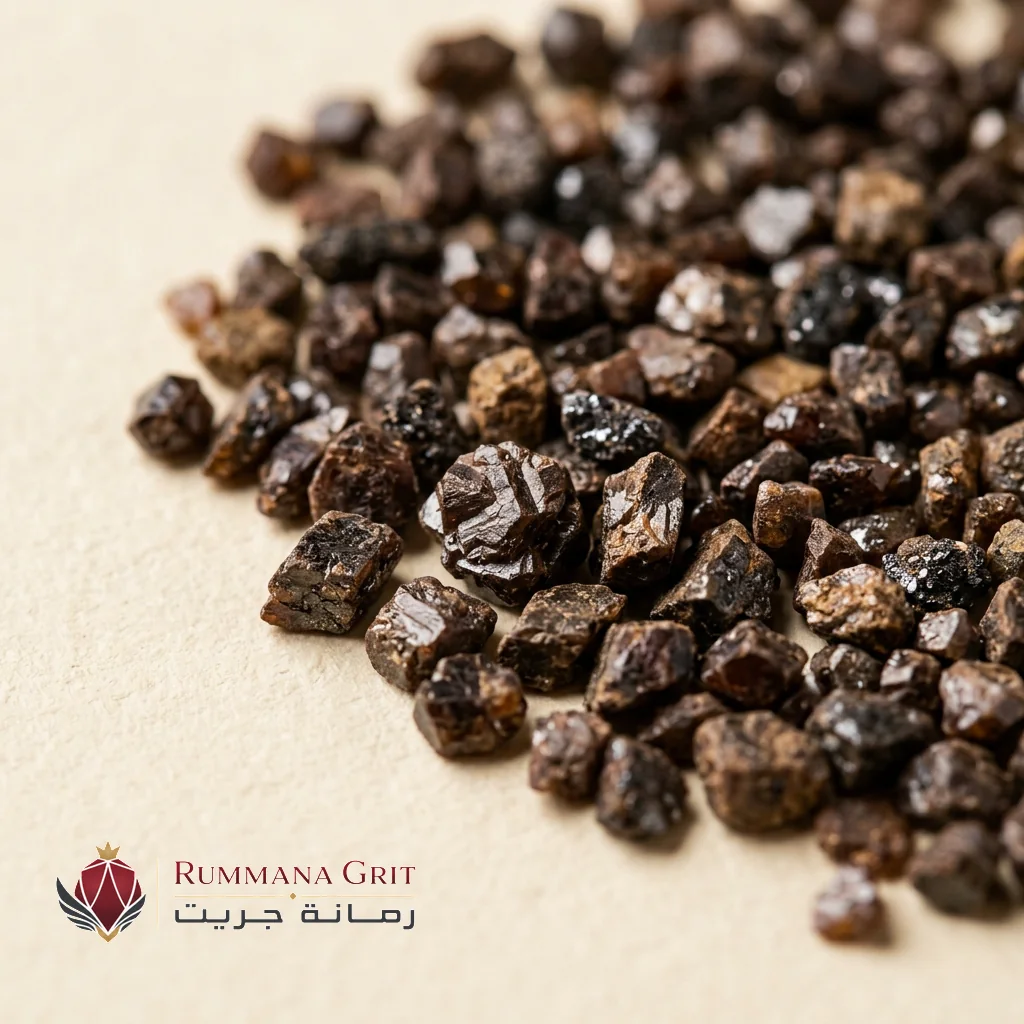
Aluminium Oxide Abrasives
Compare brown fused, white fused, calcined brown and coated alumina grains by application, treatment and sizing system. Catalogue grit scopes and preliminary anti-slip mesh selections are separate: neither a grade label nor sample chemistry is a complete purchase specification.
Rummana Grit 16/20 and 24/36 mesh brown fused alumina are preliminary anti-slip selections. Chemistry targets and sample observations below are not guaranteed batch values. Sieve and physical tests remain unverified.
How to read the technical information
Source-supported family information and recorded designations: public product-family descriptions and the named selections establish context, not confirmed inventory or batch conformity.
Typical qualitative behavior: application guidance describes how a material family may behave; qualify the actual grade and operating conditions.
Preliminary or proposed targets: explicitly marked figures are for purchase review, not supplier guarantees or certified results.
Batch-confirmed evidence: none provided. Sample observations, where stated, are not delivery acceptance evidence.
Four alumina grain families compared
These Rummana Grit ranges are FEPA F/P catalogue scopes, not stock lists, batch specifications or confirmed anti-slip grades. Specify the actual F or P designation and distribution; a bare grit number does not establish the system. The separately discussed 16/20 and 24/36 mesh anti-slip BFA selections are not interchangeable with these catalogue grit numbers.
Family descriptions indicate typical qualitative behavior, not measured hardness, friability or a promised performance gain. Confirm each grain's chemistry, treatment and physical properties against its own TDS and lot-linked tests. Do not transfer the preliminary BFA sample values or targets to WFA, calcined or coated grain.
Finished ceramic parts are not loose alumina grains. Sintered or machined ceramic components require their own composition, forming/sintering, dimensional and service specifications; this page covers grain selection, not finished ceramic-part qualification.
| Grain family | Catalogue scope | Typical applications and qualification |
|---|---|---|
| Brown fused alumina (BFA) | 8#–600#; FEPA F/P | Tough, angular general-purpose grain for qualified blasting, bonded wheels and coated belts. Refractory aggregate needs its own grading and chemistry qualification. |
| White fused alumina (WFA) | 12#–600#; FEPA F/P | Generally more friable and selected where purity, contamination or finish matters: precision grinding and finishing blasting. Refractory use requires separate qualification; colour is not a purity certificate. |
| Calcined brown alumina | 8#–600#; FEPA F/P | Brown alumina after high-temperature calcination, evaluated in resin-bonded wheels, cut-off discs and coated abrasives. Confirm treatment and trial the intended bond/process; calcination does not establish a performance improvement. |
| Coated alumina | 16#–80#; FEPA F/P | Surface-treated brown or white base grain with white/red/blue coating options. Evaluate in resin-bonded abrasives and for production identification; verify coating composition, loading, adhesion and binder compatibility. |
Calcined and coated grains: application limits
Calcined brown alumina is heat-treated brown grain, not a synonym for white fused alumina or finished ceramics. Assess the calcination effect by comparative trials in the intended bonded or coated abrasive formulation. Rummana's dedicated calcined-grain page does not offer it as refractory aggregate; do not infer that use from a generic grading chart.
Coated alumina means surface-treated loose grain, not a finished coated-abrasive belt or paper. White, red and blue describe coating options, not guaranteed composition, bond strength or slip resistance. Confirm the brown/white base grain, coating chemistry, loading, adhesion, SDS and compatibility with the intended resin system.
For anti-slip floors or decks, coated or calcined grain is not an approved substitute for the preliminary BFA mesh selections. Coating composition, binder wetting/adhesion, durability and dust/handling characteristics must be reviewed, and the client must approve the material and finished-system slip/wear test results before use. Catalogue F/P scope alone does not establish anti-slip suitability.
Preliminary BFA anti-slip grades and chemistry
The two selections under review are Rummana Grit 16/20 mesh and 24/36 mesh BFA. Treat each as a preliminary grade designation, not a verified sieve distribution. Neither designation establishes grain shape consistency, cleanliness or slip resistance in a finished floor or deck.
Two supplied sample analyses report Al2O3 at 95.53% and 96.06%. Neither sample is assigned here to 16/20 or 24/36 mesh. These observations are not guaranteed batch values, do not demonstrate all target limits, and cannot replace the COA for a delivery.
| Parameter | Preliminary target or designation | Evidence and acceptance gap |
|---|---|---|
| Grades | Rummana Grit 16/20 mesh; Rummana Grit 24/36 mesh | Sieve distributions and physical test results unverified; agree the sieve series, apertures and retained/passing limits. |
| Al2O3 | ≥95% | Preliminary target; lot conformity not established by either sample observation. |
| TiO2 | ≤3% | Preliminary target; obtain lot-linked analysis and method. |
| SiO2 | ≤1% | Preliminary target; obtain lot-linked analysis and method. Total SiO2 alone does not establish crystalline-silica exposure. |
Mesh, FEPA F and FEPA P are not interchangeable
Mesh designations depend on the sieve system and distribution limits. A nominal mesh pair does not mean every particle has a single size. Request a sieve analysis with the sieve standard, apertures, sampling method and retained/passing results for the selected grade.
FEPA F grades for bonded-abrasive grains and FEPA P grades for coated-abrasive grains use different grading systems. Neither should be inferred from a mesh label or substituted by a simple number conversion. ISO 8486 and ISO 6344 are applicable grading references only where the selected product and test scope warrant them; no compliance is asserted.
Application-led grade selection
Use trials to select grain size and material for the substrate, binder or abrasive construction. These are potential uses, not blanket suitability statements or guaranteed performance.
| Use | Selection and qualification checks |
|---|---|
| Blasting | Match grain size, angularity, friability and cleanliness to the substrate, required profile, nozzle or equipment limits, dust control and recovery system. Check contamination and embedment risk. |
| Anti-slip floors and decks | Qualify the grain distribution, binder compatibility, embedment, application rate, cure and wear behavior. Verify finished-system slip resistance under the intended wet, dry or contaminated conditions; grain chemistry is not a slip rating. |
| Bonded abrasives | Confirm the required F grading, bond compatibility, grain toughness and friability, then qualify the complete abrasive product for its duty. |
| Coated abrasives | Confirm the required P grading, backing, binder and cutting behavior. A mesh or F designation is not a substitute for a specified P grade. |
| Refractory use | Requires separate qualification for chemistry, impurities, grading and thermal behavior in the intended formulation. Abrasive or anti-slip selection does not establish refractory suitability. |
Physical properties and missing test evidence
Request measured angularity or shape assessment, hardness and friability or grain-strength data using agreed methods. These describe different aspects of cutting and breakdown; none can be inferred reliably from a generated illustration or a chemistry result.
Bulk density includes the void space between grains and depends on grading and the loose or tapped test method. True density describes the material itself. Do not substitute one for the other when estimating packing, dosing or process behavior; no numerical density is established here.
Agree impurity, free iron, soluble contaminant, moisture and dust/fines tests as appropriate to the substrate and end use. Establish the relevant silica species and exposure assessment rather than treating a total oxide limit as a safety certificate. All sieve and physical tests for the preliminary anti-slip selections remain unverified.
Documentation, lot traceability and acceptance
A technical data sheet (TDS) supports material selection; it is not proof that an individual delivery meets purchase requirements. Agree the grade, test methods, sampling plan, tolerances and acceptance limits before order. A certificate of analysis (COA) must identify the supplied lot, actual test results and methods, with traceability through bag markings, packing records and delivery documents.
Obtain the current safety data sheet (SDS) for handling, storage, personal protection and dust controls. Assess dust from the abrasive and from the substrate or removed coating, including any hazardous contaminants. Product chemistry alone does not establish the exposure risk of blasting waste. Specify ventilation, dust collection, housekeeping and waste disposal for the actual process.
No batch-confirmed results, lot-linked COA, verified sieve report or complete physical test evidence have been provided for these selections. Public catalogue descriptions, sample analyses and proposed purchase targets are different evidence classes; none establishes certification, availability or a supplier performance guarantee. Resolve missing evidence and qualify a representative sample in the intended process before order.
Public product references and evidence limits
Public family description and catalogue size examples; no numerical chemistry or density published.
Separate WFA family and catalogue size examples; not evidence for BFA targets or delivery conformity.
Heat-treated brown grain catalogue scope and bonded/coated abrasive applications; treatment benefit requires process trials.
Surface-treated grain scope and white/red/blue coating options; composition and application approval require confirmation.
These product pages provide source context, not independent verification of a supplied lot. The preliminary or proposed targets and any sample observations on this page must not be represented as public-source guarantees, certification or confirmed availability.
Establish the specification with Meritus
Send Meritus the intended use, brown/white/calcined/coated grain selection, treatment and coating requirements, required sizing system, substrate or binder, acceptance tests, quantity and destination. Identify any preliminary anti-slip mesh target separately, obtain client approval where required, and request lot evidence and a qualified sample before order.
Contact Meritus about procurement requirements