
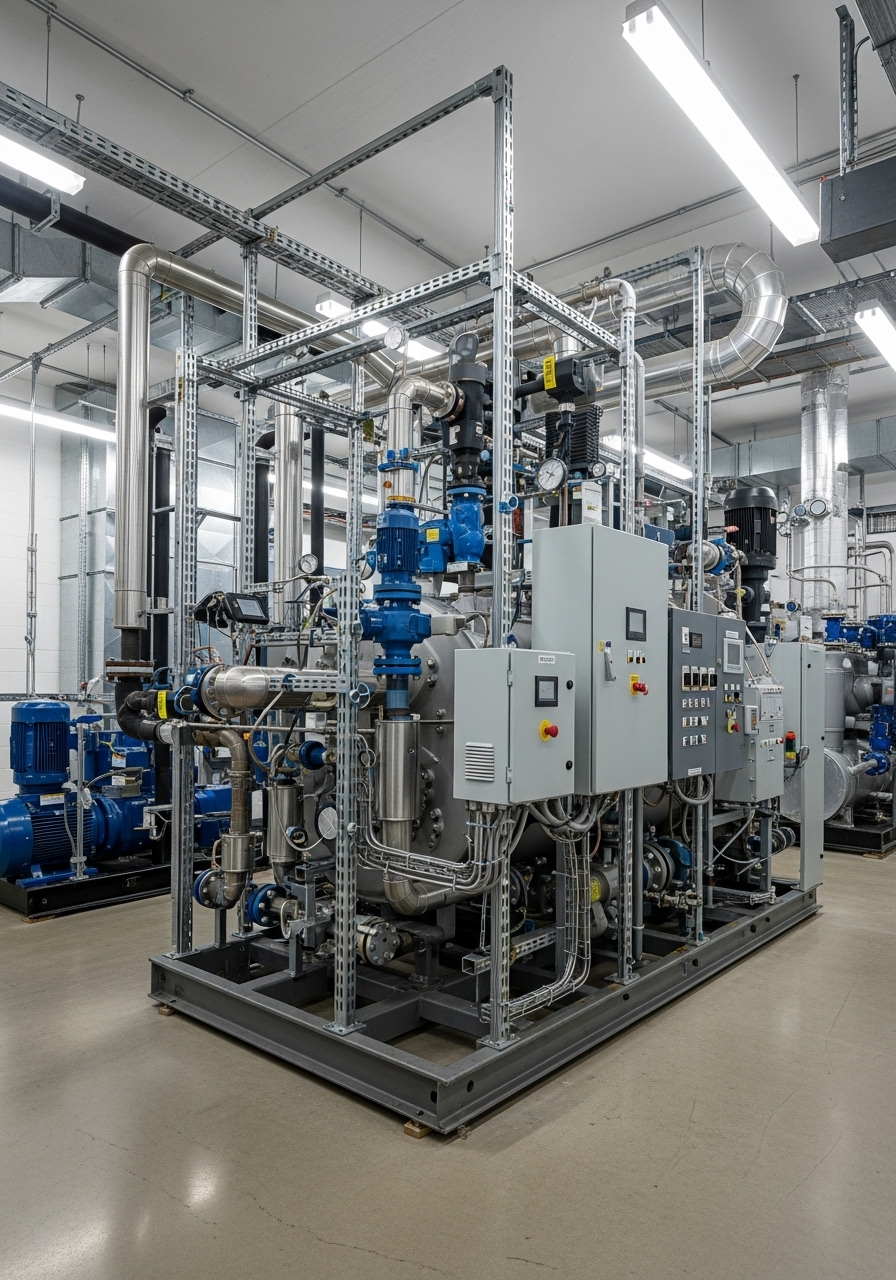
Cooling Towers & Heat Exchangers
Industrial cooling towers and heat exchangers for process cooling, power generation, and HVAC applications with corrosion-resistant construction.
- Identify whether the RFQ is for a cooling tower, heat exchanger or combined cooling package; define the equipment boundary and the required heat rejection duty.
- For a cooling tower, provide water flow, entering and leaving water temperatures, design wet-bulb temperature and site elevation. Ask how the proposed selection meets that design point.
- For a heat exchanger, provide hot- and cold-side fluids, flow rates, inlet and target outlet temperatures, operating and design pressures, and allowable pressure drops.
- Describe water chemistry, solids and fouling risks; ask for the material-selection basis and the proposed cleaning and water-treatment scope.
- Confirm plot area, access, utility connections and any project noise or plume constraints before comparing offers.
Cooling towers and heat exchangers require different selection inputs. The catalog lists counterflow, crossflow and induced-draft tower configurations, a 100 to 50,000 tons cooling-capacity range, and galvanized steel, stainless steel and FRP materials. Use these as a starting range for an enquiry, not a guaranteed duty or a specification for every heat exchanger.
Selection checks for your RFQ
- Identify whether the RFQ is for a cooling tower, heat exchanger or combined cooling package; define the equipment boundary and the required heat rejection duty.
- For a cooling tower, provide water flow, entering and leaving water temperatures, design wet-bulb temperature and site elevation. Ask how the proposed selection meets that design point.
- For a heat exchanger, provide hot- and cold-side fluids, flow rates, inlet and target outlet temperatures, operating and design pressures, and allowable pressure drops.
- Describe water chemistry, solids and fouling risks; ask for the material-selection basis and the proposed cleaning and water-treatment scope.
- Confirm plot area, access, utility connections and any project noise or plume constraints before comparing offers.
These are existing catalog entries for the range. The capacity unit and duty basis, tower configuration, material and treatment scope need confirmation for the quoted equipment; they do not define a heat exchanger's thermal or pressure rating.
- Cooling Capacity
- 100 to 50,000 tons
- Tower Types
- Counterflow, crossflow, induced draft
- Standards
- ASME PTC 23, CTI STD-201
- Materials
- Galvanized steel, stainless steel, FRP
- Water Treatment
- Integrated treatment systems
- Process cooling: define the process fluid, temperature targets and whether a separate cooling-water circuit is required.
- Power generation: provide the cooling-system duty and seasonal design conditions rather than selecting by nominal catalog capacity.
- HVAC: define the condenser-water or heat-transfer duty, available services and site constraints.
- Request the proposed equipment's general arrangement, operating weight and connection schedule before planning supports or foundations.
- For towers, review airflow clearances, water distribution, basin access and maintenance access against the supplier's layout.
- For exchangers, agree piping interfaces, isolation, drainage and cleaning access; confirm how thermal movement will be accommodated.
- Define flushing, water-treatment and commissioning responsibilities in the purchase scope. Use the selected equipment's instructions, not a generic installation timeline.
- Request a selection calculation or thermal datasheet tied to the stated design conditions, including the scope and limitations of the proposed duty.
- For towers, ask whether and how the catalog-listed ASME PTC 23 and CTI STD-201 references apply; agree any required verification evidence before ordering.
- For exchangers, specify the applicable project design code and required pressure or inspection documentation in the RFQ rather than assuming tower references apply.
- Clarify whether the catalog-listed integrated water treatment is included, optional or outside the quoted scope.
- Agree drawings, maintenance instructions, spare-parts scope, warranty terms and delivery requirements; no fixed efficiency, service life or support response is assumed.